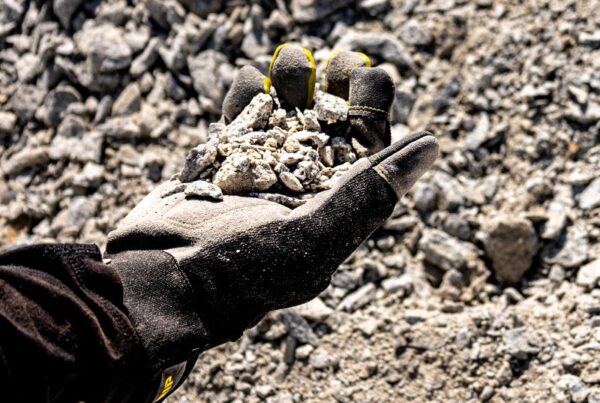
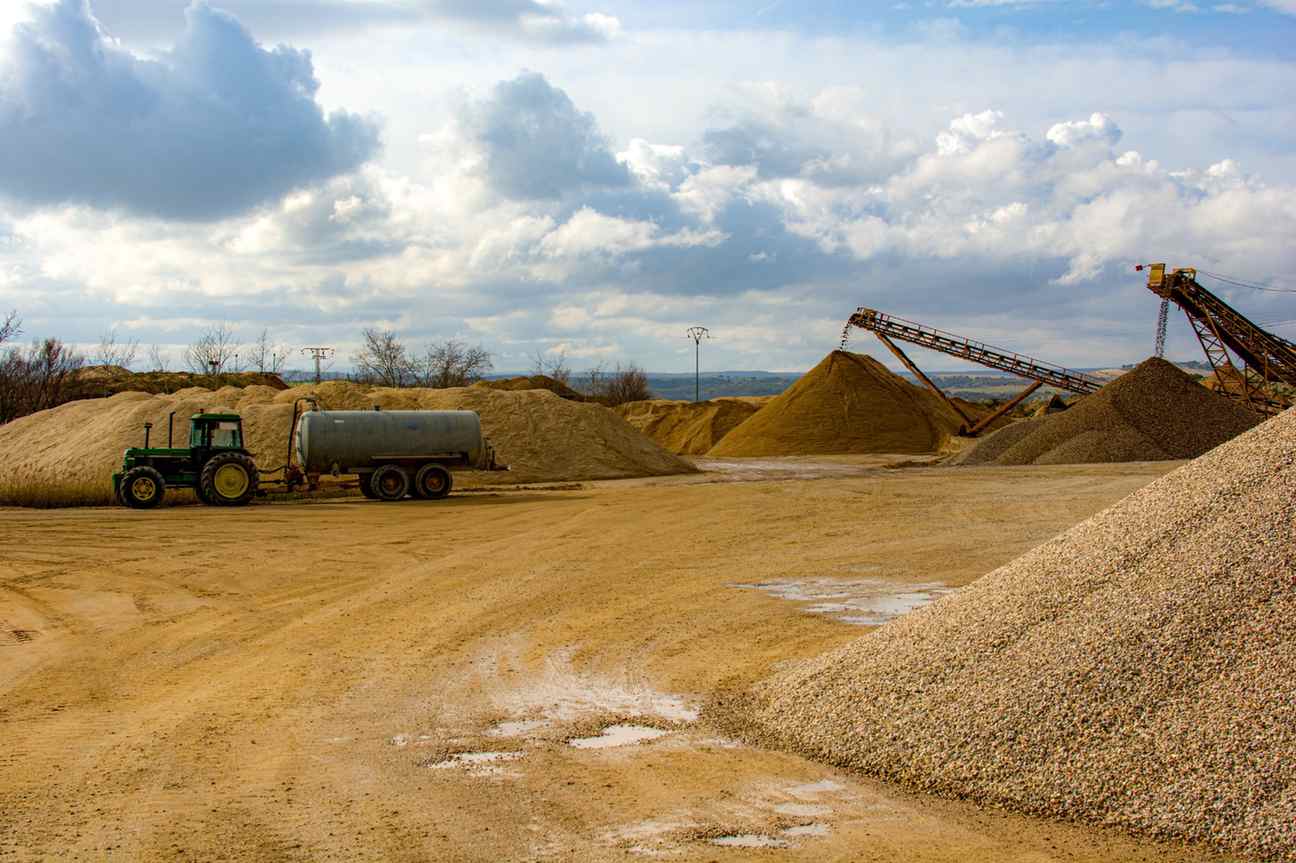
You can call just about any quarry and ask for rock.
The trick is getting the right rock.
Class II Aggregate Base and ¾-inch crushed rock may both come out of a quarry. They may both involve crushed stone. They may even look fairly similar to somebody who doesn’t work with aggregate every day.
They are not interchangeable.
The difference becomes pretty obvious once you spread the material, put water to it and start running a roller over it.
Class II base is designed to build a dense, compacted layer. Clean crushed rock is useful when you want the characteristics of the individual stone and the void spaces between it.
One locks together.
The other allows space between the particles.
Which one you want depends on what you’re building.
What Is Class II Aggregate Base?
Class II Aggregate Base is an engineered aggregate blend used extensively in California construction.
Caltrans treats aggregate base as part of the pavement structure and specifies Class 2 and Class 3 aggregate bases under Section 26. Project plans determine the class, thickness and placement requirements.
The important word is graded.
Class II isn’t simply a pile of rocks that are all the same size.
It contains a distribution of particle sizes, including fines.
Those smaller particles fill spaces between larger aggregate. With the correct moisture and compactive effort, the particles rearrange and pack together into a dense mass.
That’s exactly what you want underneath pavement, concrete and other surfaces requiring a stable foundation.
The Fines Aren’t an Accident
This is where people unfamiliar with aggregate sometimes get confused.
They see fines and think the material is dirty.
Not necessarily.
In a properly produced aggregate base, the smaller material is part of the product.
Caltrans specifications actually establish gradation limits at multiple sieve sizes. For example, the specification provides percentage-passing requirements down through the No. 200 sieve for Class II Aggregate Base.
That particle-size distribution is a major part of what gives aggregate base its compaction characteristics.
The big pieces create structure.
Intermediate particles fill larger spaces.
Fine particles fill smaller spaces.
Add the appropriate moisture and compaction, and the mass becomes significantly denser.
That’s why Class II works as base.
What Is Crushed Rock?
Crushed rock is exactly what the name suggests: rock mechanically crushed to a specified size or gradation.
But that description covers a lot of products.
At Lynx Cat, for example, crushed granite products include 3/8-inch and ¾-inch crushed rock in addition to Class II Aggregate Base.
The critical question is what sizes and fines are included in the product.
Clean crushed rock has fewer fines and retains more open space between individual particles than a dense-graded aggregate base.
That makes it useful where drainage is important.
Water can move through those void spaces rather than sitting on top of a tightly compacted layer.
Think About What You Need the Rock to Do
This makes the decision much easier.
Do you need the material to compact into a stable base?
You’re probably looking at an aggregate base product.
Do you need the material to remain relatively open so water can move through it?
Now you’re looking at clean crushed rock or another drainage aggregate, depending on the specifications.
That’s an oversimplification—engineered projects can have very specific requirements—but it is a useful way to understand why these materials behave differently.
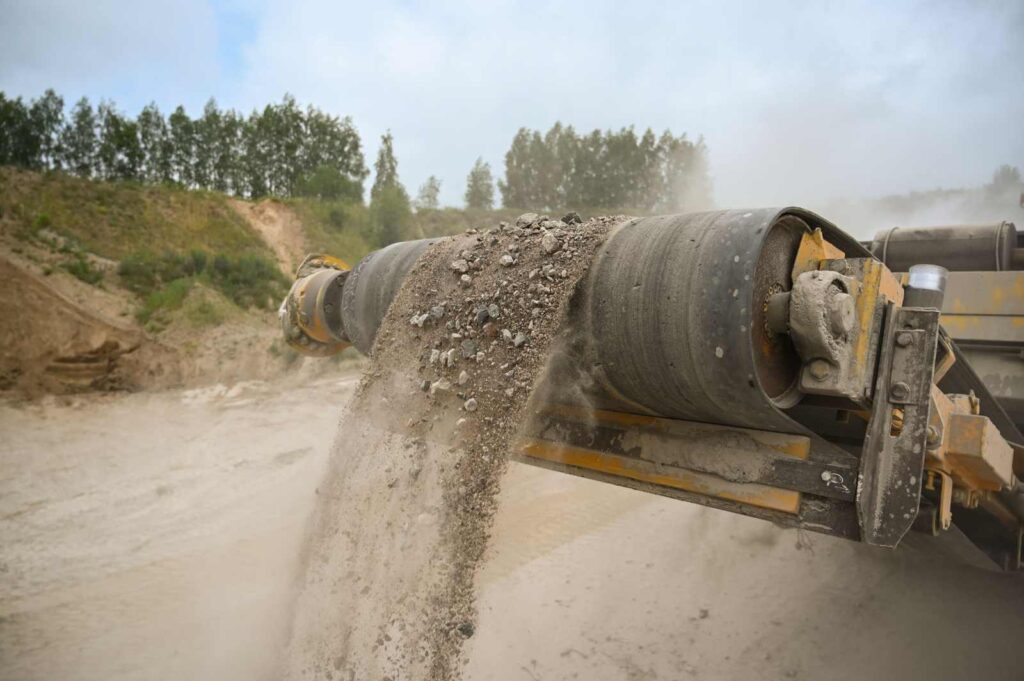
Where Is Class II Base Used?
Class II base shows up all over California construction.
Parking areas.
Pavement sections.
Building pads.
Utility work.
Concrete flatwork.
Equipment areas.
The exact section depends on the engineer and project.
Lynx Cat has supplied Class II Base on major High Desert projects, including work at Fort Irwin and China Lake.
That isn’t decorative rock.
It’s working material.
Compaction Is Part of the Job
Ordering good Class II doesn’t guarantee a good base.
You’ve still got to place it correctly.
That means paying attention to subgrade preparation, lift thickness, moisture and compaction.
Dumping a thick pile of material and hammering the top with a roller isn’t the same thing as achieving uniform compaction through the full section.
On engineered work, compaction requirements come from the project specifications.
Caltrans acceptance procedures include tests for gradation, sand equivalent, R-value, durability, moisture, maximum wet density and relative compaction, depending on the material and application.
In other words, on serious infrastructure work, “looks pretty good” isn’t a test method.
Where Does Clean Crushed Rock Make Sense?
Clean crushed aggregate is useful in applications where you don’t want the material behaving exactly like dense-graded base.
Drainage is the obvious example.
If the goal is moving water, the spaces between aggregate particles become useful.
Clean crushed rock may also be specified for utility, structural, surface or other applications depending on the project.
Again, follow the plans.
A contractor should never replace a specified base with clean rock—or clean rock with base—just because the nominal top size looks similar.
What About ¾-Inch Rock?
This is where terminology can get sloppy.
Someone says:
“I need three-quarter.”
Okay.
Three-quarter what?
¾-inch Class II?
¾-inch crushed rock?
¾-inch clean rock?
A ¾-inch maximum particle size does not tell you the entire gradation.
Caltrans, for example, has a defined ¾-inch maximum Class II Aggregate Base gradation with specified percentages passing the ¾-inch, No. 4, No. 30 and No. 200 sieves.
The smaller particles matter.
That’s why the complete specification matters.
How Much Class II Base Do You Need?
Don’t forget that loose material and compacted material aren’t the same volume.
Once aggregate is moisture-conditioned and compacted, particles rearrange and void space decreases. Lynx Cat’s estimating guidance recommends accounting for roughly 15–20% shrinkage for Class II base and many crushed-granite applications when moving from loose to compacted volume.
That can become a big number on a large job.
Ordering exactly the calculated compacted cubic-yard volume can leave you short.
And being short tends to become obvious at the least convenient time possible.
Get the Spec Before You Get the Rock
If you’re working from engineered plans, don’t guess.
Look at the material specification.
Check the maximum size.
Check the gradation.
Check the testing requirements.
Check the quantity.
Then call Lynx Cat Mountain Quarry.
We would much rather look at the requirement before you order than explain afterward why the material delivered for one application doesn’t meet the specification for another.
Need Class II Base or Crushed Granite?
Lynx Cat Mountain Quarry produces Class II Aggregate Base, 3/8-inch crushed rock, ¾-inch crushed rock and other granite aggregate for construction throughout the High Desert.
We serve contractors working around Barstow, Hinkley, Fort Irwin, China Lake and surrounding areas.
Call 760-760-5969. Tell us what you’re building, send us the spec, and we’ll help you get the right rock headed to the job.