Let’s talk about the moment every project manager dreads: standing in front of a job site, squinting at a spec sheet, and trying to figure out how many truckloads of aggregate to order without either running short on a Friday afternoon or ending up with a small mountain of leftover rock nobody wants.
You’re not alone. “How much aggregate do I need?” is one of the most Googled questions in construction. Here’s how to actually answer it — without a headache.
The Basic Aggregate Calculator (Don’t Worry, It’s Simple)
Aggregate is measured by cubic yards or tons. To figure out how much you need, you start with three measurements:
- Length (in feet)
- Width (in feet)
- Depth (in inches)
Then you run this:
Length × Width × (Depth ÷ 12) = Cubic Feet Cubic Feet ÷ 27 = Cubic Yards
From cubic yards, you convert to tons using the material’s weight. Crushed granite aggregate runs about 1.35–1.5 tons per cubic yard, depending on gradation and moisture.
Quick Example
Road base for a 500-foot access road, 20 feet wide, 6 inches deep:
500 × 20 × (6 ÷ 12) = 5,000 cubic feet 5,000 ÷ 27 = 185 cubic yards 185 × 1.4 = ~260 tons
That’s roughly 22–26 standard end-dump trailer loads. Plan accordingly.
How Deep Should You Go for Aggregate?
Depth matters — and it changes by application:
| Use | Typical Depth |
| Foot path / light traffic | 2–3 inches |
| Parking lot or driveway | 4″ surface + 6″ Class II base |
| Road base (light vehicles) | 6 inches compacted |
| Road base (heavy trucks) | 8–12 inches compacted |
| Railroad sub-ballast | 8–12 inches |
| Drainage fill | Varies; consult engineer |
Compaction is key — base materials can lose 15–25% of their loose volume when compacted. Build that into your order or you’ll come up short at the worst possible time.
Don’t Forget the Swell Factor with Your Aggregate Calculator
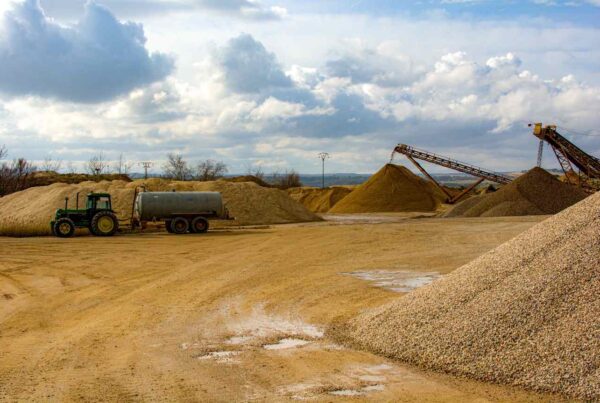
Here’s where a lot of orders go sideways. Aggregate sitting in a pile or in the back of a truck is in its “loose” state — it has air gaps between particles. Once you spread and compact it, it settles into a denser state and the volume drops.
For Class II base and most crushed granite, assume about 15–20% shrinkage after compaction. That means if your plan calls for 100 compacted cubic yards, you need to order around 120 loose cubic yards to end up with what you need.
Miss this and you’re making a Friday afternoon phone call asking for an emergency delivery. We’ve gotten that call. We’d rather help you get the math right before it becomes a problem.
Product-Specific Notes
Different materials have slightly different weights and pack-out characteristics:
- 3/8″ Crushed Rock — about 1.3–1.4 tons/cy; great for drainage layers and surface finish
- 3/4″ Crushed Rock — about 1.4–1.5 tons/cy; road base, sub-base, general fill
- Class II Base — about 1.4 tons/cy compacted; standard for Caltrans road work and parking lots
- Railroad Ballast — about 1.5 tons/cy; specified gradation, engineered per project
- Rip Rap — varies widely by stone size; call us for tonnage estimates on large rock
A Few Rules of Thumb by Project Type
If you don’t want to do the full math right now, these ballparks will get you in the ballpark:
Parking lot (1 acre, Class II base at 6″ compacted): roughly 1,100–1,200 tons
Access road (1,000 linear feet × 20 ft wide, 8″ base): roughly 650–700 tons
Residential driveway (100 ft × 12 ft, 4″ base + 2″ surface): roughly 35–45 tons total
These are estimates. Soil conditions, existing grade, and material specification all affect the final number. But they’re close enough to sanity-check a quote or ballpark a bid.
Don’t Under-Order (But Don’t Way Over-Order Either)
A general rule of thumb: add 5–10% to your calculated quantity to account for waste, spillage, and the inevitable “wait, we need just a little more” moment. For large projects, keep a unit rate in your back pocket and add buffer tonnage to your purchase order.
Under-ordering stops jobs. Over-ordering wastes money and creates stockpile problems your super doesn’t want to deal with. Somewhere in between is the sweet spot — and a quick phone call to us before you finalize the order is usually all it takes to land there.
We’ll Help You Figure It Out
At Lynx Cat Mountain Quarry, we’re not just a materials supplier — we’re a resource. Give us your dimensions, your spec, and your timeline, and we’ll help you nail the quantity before bid day, not after delivery day.
Call us today: 760-760-5969. Same-day pricing, every time.