There is nothing complicated about the basic idea behind trackout rock.
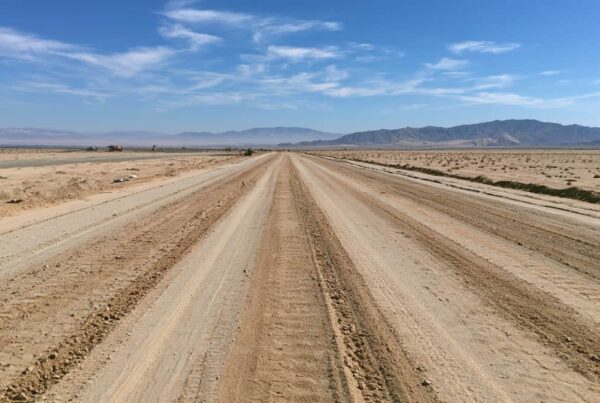
You have trucks and equipment leaving a dirt construction site. Their tires are carrying mud, dirt and loose material with them. If that material ends up all over the public road, you have a problem.
A properly built stabilized construction entrance gives those trucks a rough, durable rock surface to cross before they hit pavement. As the tires roll over the aggregate, much of the loose dirt and mud gets knocked free before the truck leaves the site.
That’s trackout rock.
But there is an important distinction here: trackout rock isn’t just whatever rock happens to be sitting around the yard.
Size matters. Gradation matters. The hardness of the material matters. And the way the entrance is constructed matters.
If you’ve got loaded trucks running in and out of a job all day, you need rock that will hold up to the traffic.
What Is Trackout?
Trackout is the dirt, mud and other material carried from a construction site onto a paved roadway by vehicle tires.
You’ve seen it before.
A truck comes off a dirt jobsite and leaves two brown tracks down the street. After enough trucks make the same trip, you’ve got dirt spread across the roadway.
Besides making a mess, sediment leaving a construction site can become a stormwater and compliance issue. That is why stabilized construction entrances are common on grading, utility, road and other large earthwork projects.
The idea is to deal with the dirt before the truck reaches the street.
Why Use Large Rock?
This is one of those applications where smaller isn’t necessarily better.
If you put down a layer of fine crushed material and run muddy tires across it, the surface can quickly start behaving like more dirt. Fine material can work its way into the mud, while tires may simply roll across the relatively smooth surface without shedding much material.
Larger angular aggregate creates a rougher running surface.
As tires roll across it, they flex and move over the irregular stone. That helps break loose material out of the tire treads.
The rock also needs enough strength to withstand repeated traffic without immediately crushing into fines.
That’s particularly important when the traffic isn’t a pickup truck and a couple of guys coming to work in the morning.
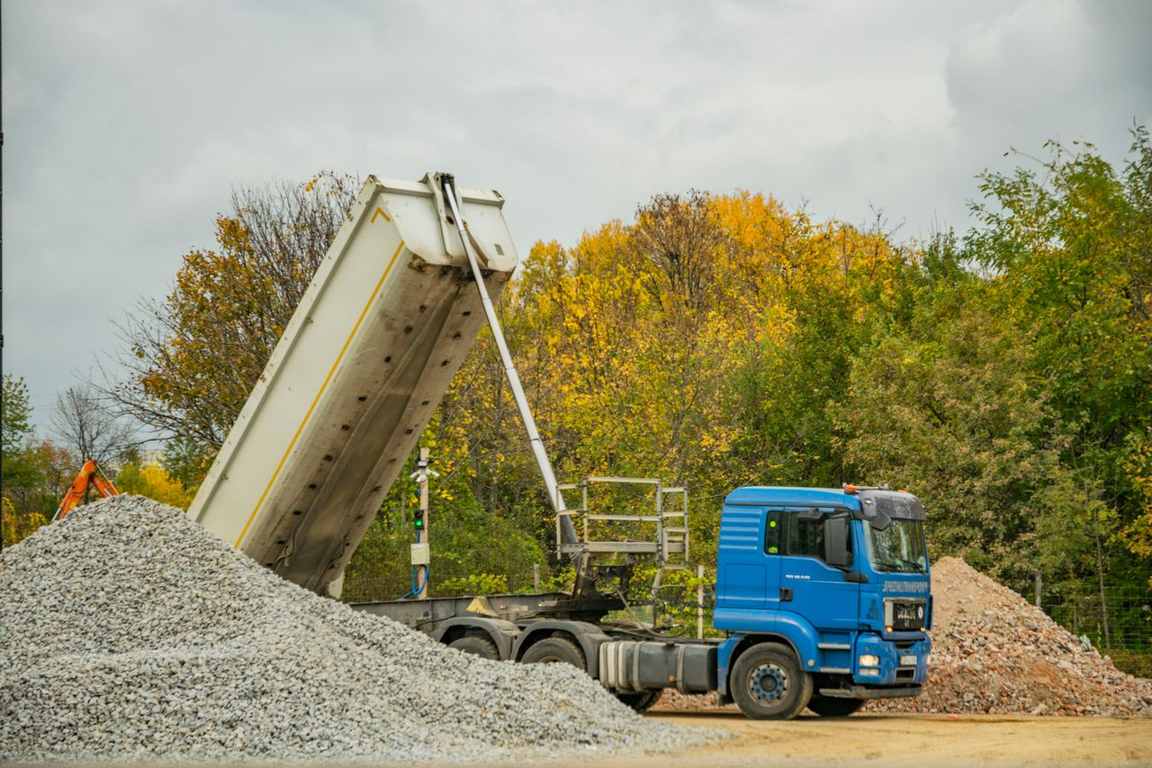
We’re talking about dump trucks.
Water trucks.
Loaders.
Concrete trucks.
Lowboys.
And other heavy equipment entering and leaving the site throughout the day.
The entrance has to take the abuse.
What Size Rock Is Used for Trackout?
There isn’t one universal rock size for every stabilized construction entrance. The plans, SWPPP requirements and applicable agency specifications should always control the material used on a particular project.
That last part matters.
If the project specifies a particular gradation or construction entrance detail, build what is specified.
Don’t substitute material because something else happens to be cheaper or already sitting in a stockpile.
For jobs where the contractor has some discretion, larger crushed rock is generally preferred over small aggregate because you want enough stone size and angularity to interact with the truck tires and remain functional under traffic.
The quarry should know what you’re trying to accomplish before loading the trucks.
“I need some rock” isn’t much of a material specification.
“I need rock for a stabilized construction entrance” is a much better start.
Angular Rock Matters
Rock shape is easy to overlook.
Rounded gravel behaves differently from crushed granite.
Think about a pile of marbles compared with a pile of broken pieces of stone. Rounded particles tend to roll and move against one another. Crushed aggregate has fractured faces and irregular edges that allow the material to interlock.
For a construction entrance, that rough angular character is useful.
You want a durable surface that stays put reasonably well under traffic while also creating enough irregularity to help clean tires.
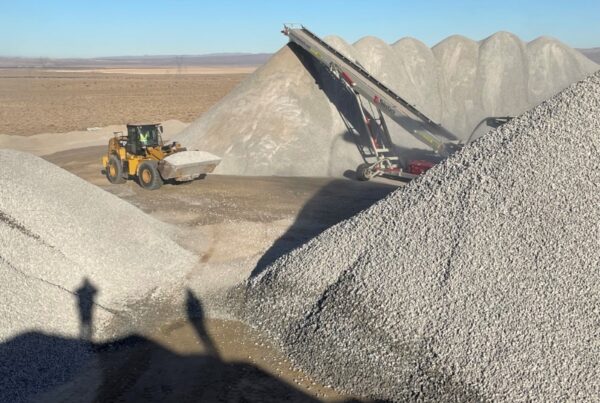
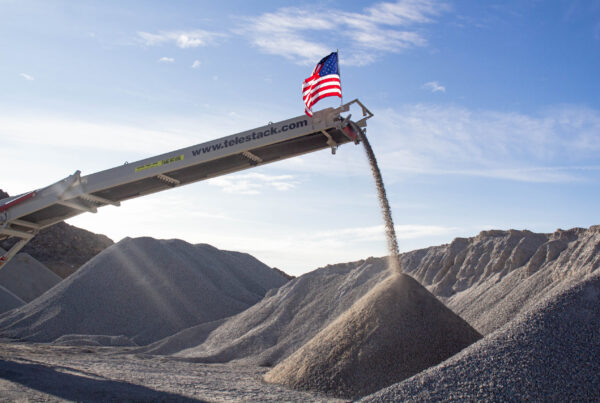
Lynx Cat Mountain Quarry produces crushed granite in the High Desert for heavy construction applications. The quarry supplies aggregate for infrastructure, military, road and rail work in the Barstow, Fort Irwin and China Lake areas.
Depth Matters Too
Good rock can’t fix a badly constructed entrance.
Put a thin layer of stone over soft soil and then start running loaded trucks across it. What happens?
The rock starts disappearing.
It gets pushed into the underlying soil, rutted, displaced and contaminated with fines. Pretty soon you’re looking at dirt with some expensive rocks buried in it.
That’s why stabilized entrances are built as a system rather than simply dumping a load of rock at the gate.
The subgrade condition matters.
The specified entrance depth matters.
Geotextile may be required depending on the project design.
The entrance also needs sufficient length and width for the actual vehicles using it.
A construction entrance designed for pickup traffic is a different animal once end dumps start cycling through it all day.
Maintain the Entrance
Another mistake is treating trackout rock as a one-and-done installation.
It isn’t.
A construction entrance is a working part of the jobsite.
Mud accumulates.
Rock moves.
Ruts form.
Fine material fills voids.
Heavy traffic breaks material down.
If the entrance stops removing material from the tires, it isn’t doing its job anymore.
That may mean regrading it, adding fresh rock or otherwise maintaining the entrance throughout the project.
You also still need to deal with material that makes it onto the roadway. A construction entrance helps control trackout. It doesn’t make road maintenance unnecessary.
Don’t Order Rock Based on the Name Alone
This applies to almost everything we sell.
Know what the project requires.
If there is a specification, send it over.
If there is a gradation requirement, we need to know it.
If you’re bidding a job and trying to determine what material makes sense, talk to Lynx Cat quarry before you finalize the number.
The cost of getting the wrong material isn’t limited to the rock.
It’s trucking.
Equipment.
Labor.
Removal.
Replacement.
And potentially a crew sitting around while somebody figures out how quickly the correct material can get there.
That is an expensive way to save a phone call.
Need Trackout Rock in the High Desert?
Lynx Cat Mountain Quarry supplies hard granite aggregate for contractors throughout Barstow, Hinkley, Fort Irwin, China Lake and the surrounding High Desert.
Tell us what you’re building and what the job requires. If you’ve got a project specification, send it to us. We’ll help you get the right material lined up before the trucks start moving.
Call Lynx Cat Mountain Quarry at 760-760-5969 to talk rock, specs, tonnage and delivery.